Saturday, March 31, 2018

Studio Visit: Debra Claffey, New Hampshire

Edited by Paula Fava

Debra Claffey moved from Boston to Southern New Hampshire in 1992. She converted a small horse barn on her property into a studio with the aid of a big book called Building and Construction Details. "It had lots of easy-to-follow diagrams," says Debra, "so I taught myself some carpentry and got a studio in return."    


   An open and expansive workspace after a summer’s labor of love 
and years of continued work 

                            
 Cozy and comfy during winter which, in New England, can last into spring


“I love that my workspace is on my property and near but not attached to my home. I like the quiet and the easy 'commute.' I work in the studio daily now (since I’ve downsized my landscape business), mostly afternoons and early evenings. I have found that I more easily relax into good concentration when the household chores are done first, but with a time limit.


 This old studio: Pre-remodel images of Debra’s barn, 1992


“My ventilation for encaustic is homemade--a quiet but strong bathroom exhaust fan coupled with metal dryer vent, hanging from a copper pipe, which makes it movable. The garden swing, my plants, and books make it comfy, but with everything on wheels, and with lots of cabinets, the studio is very utilitarian. I have a propane heater for backup but keep cozy and warm with a wood stove. It's a bit of work to stack and move the wood, but it's wonderful during the winter.


Debra calls her studio utilitarian but comfy. You can guess which category the swing falls into


“I work alone and really appreciate the solitude, although I did enjoy having lots of artists and conversation around in my first studio in Boston. I’ve begun teaching workshops with one to four artists, so now I have the best of both.

        Creating community through workshops


“I'm working with plant and foliage imagery using encaustic, pigment stick, graphite, and other media that suit my drawing and painting style. I've been working with plants and a few still life objects for more than 10 years, but am still intrigued by the intelligence of nature and the complexity of translating it into my own visual language.”

              Debra with two foliage-influenced works in progress            
                  

In Residence: The Quest for My Ideal Art Residencies

By Heidi F. Beal


Over the past couple of years, I've been ramping up my interest in art residencies. Teasing through the vast number of different offerings has forced me to follow wise advice Ruth Hiller gave during a presentation at the International Encaustic Conference in 2015: “Be clear about your residency goals.” This goal might be to have a strong resume line, or better studio space for a specific project, or a respite from the daily grind, or inspiration in an artist-friendly place. Perhaps all of the above.


Heidi Beal in front of the historic Klingel House, location of the art residency at the Gettysburg National Military Park. She found it "while gallivanting the Pennsylvania countryside in October of 2017, with some help from a park ranger"

 
What does my ideal residency look like?
I have a long list of residency desires, but I certainly don’t expect to find them all in one experience. These are my goals:
. The residency combines into one experience my interest in travel to remote places, rest, introspection, and a strong focus on my art practice
. It is located in a peaceful, inspiring, and non-distracting location
. It springs my work forward, giving me energy that lasts long after the residency is over
. There’s access to studio resources or expertise that I don’t have at my home studio. (i.e. larger space, access to technical equipment or expertise)
. The residency builds relationships (before, during, or after) with people who can help me propel my career forward
. When I’m at home, cooking and food planning drains my creative energy, so an ideal residency would be one where I would have nutritious meals prepared for me
. A prestigious resume line item would be nice but not required
. Ideally my husband would join me and have mental space to work on his writing

I've applied to a few but haven’t been accepted yet, probably because on a cosmic level, the timing wasn’t right. I was passed up after being in a three-way tie for last year's residency at Loggerhead Island in The Dry Tortugas—you know the one where you and your partner are on a remote island all by yourselves? It took place in September of last year at the exact time that Hurricane Irma hit, and the folks who did get it had to be evacuated.

Pamela Winegard reflected on the breadth of ideal offerings at the Vermont Studio Center, a venue where she has has spent time more than once. “If you want to work 24/7, you can pursue that; if you need to rest and reflect, that time is available to you; and if you need other creatives to explore new ideas, that is there as well. I was able to use all of these in my month-long residencies to let go of my outside obligations and responsibilities and just focus on me and my creative expression.”


Researching the residency
I’ve been making a point of visiting some of these residencies to see if they are a right fit. This has given me an enormous amount of information I would never have gotten from online or printed information. What I’ve found is that the residency announcements do not tell and show the whole picture. Before investing the time and money in applying, do a deep dive and make sure the residency is in line with your checklist of goals.

Although the locations may seem romantic in the pictures, don’t assume anything about what is provided and not provided. Talking to alumni/ae is helpful, but their goals and perspectives may be different.

Paula Roland recounts this story about her 2008 residency in Auvillar, France, part of the Virginia Center for Creative Arts' program: “I was told that they would have lots of beeswax for me, so not to worry. When I arrived I was handed what looked like a half pound. Yikes, for a month! Eventually the director found a beekeeper. Imagine my surprise when he turned up with about 50 pounds. I kept half. It was a gorgeous yellow (from pollen) that I mixed with resin and used with locally sourced pigments and encaustic paint that I had brought with me.” 


Paula Roland, left, with a local beekeeper during her 2008 residency in Auvillar, France, part of the Virginia Center for Creative Arts' program. 


There may even be situations where studio space is non-existent, such as Leslie Sobel’s Arctic residency. If you plan to work on site, this would be an issue. If lodging is provided, it may be on a busy street or in a distracting tourist location. It helps to think of an art residency as a form of travel. When traveling you need to be flexible, prepared, and open to whatever experience it brings (although who’s prepared for a hurricane?). On the flip side, make sure your basic lodging needs will work for you.

The venue's perspective
Let’s look at this issue of assumptions and artists’ needs from a venue’s perspective. People from each organization are reviewing a deluge of applications, presumably making decisions based solely on what is provided in the applications. They do this not really knowing the personalities of the artists they are inviting to their venues for extended stays. [When a phone referral is required, one of the questions may be, “How does the applicant get along in a group situation?”—ed.]

Here’s what John Cargill of the National Parks Arts Foundation said when I suggested that studio space and lodging details would be helpful in their residency announcements: “Studio space is usually arranged after an artist is accepted and has included it in their proposal requests. We have even had an RV delivered upon request just to be a studio.”

As for specifics or location and amenities, he said, “When we did post all of that information to the public (including photos), it caused more questions and demands than were necessary. We have had everything from someone demanding we have an air quality test done, to demanding all the heads on the nails in a bedroom be brass, to threatening to not come because a salad spinner wasn't provided, to wanting an avalanche airbag for their non-service pet (pets not allowed at that residency anyway).

“I don't know if we are missing any more great artists than we have or want, or who want us. The truth is, we offer the best but we aren't going to put more impressive bravado on it than necessary for great inspiration and excellence in art. We are interested in artists who want to work with us and we do all we can for them.”


The financial side of art residencies
There are lots of credible art residencies out there. Many offer generous stipends, while an equal or greater number require that you pay to attend. Most offer a good deal for your money—including materials, meals, programmed events, even scheduled visits by curators or critics.

Winston Lee Mascarenhas has attended several residencies. “Some of the most prestigious artist in residency programs are pay for play with some grants available for a small percentage,” he says.

One of the residency programs on my wish list is the Vermont Studio Center. Regarding fees, their website says, “We are very grateful to those residents who opt to pay for their residency in full, as it allows us to offer need-based financial aid to other talented artists and writers who would be unable to attend without assistance.” So, if you can pay, your fees contribute not only to your own art practice but to the arts community at large. Winston adds, “The great benefit from all good residencies, regardless of financial considerations, is the networking, and the interaction with artists and writers that you would never have otherwise.  It all informs your growth and work as an artist.”

Fees I’ve paid have ranged from $35 to $110. These fees can add up. To a credible art organization, the financial sting is lessened if you consider it a tax-deductible contribution or a business expense. But application fees are just a drop in the bucket compared to the cost of travel and taking a chunk of time out of your life. 

Some artists apply for grant funding. Pamela Winegard was able to obtain financial assistance and fellowships to attend her residency but says, “What I did have to pay for was worth it.”

Others may 
teach workshops in conjunction with their residency to help with funding. 


Relatedly, an artist-in-residence program at a school or university, which could last for a few days or as long as a semester, typically comes with a salary and studio space. In the Fall of 2016, Kim Bernard was the artist in residence at the University of New England in Maine. Throughout the semester, she collaborated with faculty members, incorporating art into the topics being studied. Kim’s high degree of community involvement and time commitment is typical of an artist in residence, which is different from an artist residency.


Above: Kim Bernard with Amy Deveau's chemistry class during an indigo dying project. Says Kim: “We hung the dyed fabrics on a line to dry, then created an art installation in the main stairwell of the Harold Alfond Center for Health Sciences.”

At right: the indigo installation


One of the ways my husband and I are making our travel and art residencies a reality is by downsizing to one camper van and renting out our house while we’re away. Strategic planning has been key. Ruth Hiller’s advice about keeping our goals in clear focus has been invaluable.

I’m also realizing I may be able to have a rich art residency by simply renting my own farmhouse, warehouse, or old retail space for a few months, separate from any organization. Going through residency organizations may not be aligned with my goals. Some applications have unneeded hoops to jump through and rack up application fees with no guarantee of return.
Over to you
What are your art residency goals? How have you funded your art residency? What unusual experiences have you had? Please share in the Comments section below.

. . . . .
  
More Info
According to the Alliance of Artists Communities, there are an estimated 500 artists’ communities in the United States and more than 1500 worldwide, which provide residencies to 30,000 artists a year (10,000 in the U.S.) .Visit their website for much more information.


Open Call: What If?

This article originally appeared in the December/January issue of the Brooklyn Rail 
in the Critic's Page edited by Taney Roniger

By Lorrie Fredette

Lorrie Fredette, The Great Silence, 2017. Beeswax, damar resin, muslin, brass, 
nylon line, suspended above floor


Many of us in the arts now feel we have to prove our worth and relevance by building partnerships with and serving other fields. I work with scientific ideas and imagery, and this has been my experience.  


As someone who has spent most of her career working in the sci-art genre, I am often called upon to identify ways to draw more science and technology professionals into our field—but art's function is not to translate science. Data visualization can produce remarkable schematic forms, but it is not art. An illustration paired with scientific text aids the language of science, but is not art. These are supporting actors. They will never be offered the leading role.

When we incorporate science into our work, we are making no claim to be scientists. We are not appropriating scientific research and calling it our own. We are not re-presenting scientific findings in a visual format, factually or abstractly. We are not remotely suggesting our work is their work manifested as a painting, a sculpture, a computer animation, or an installation.

While I can’t speak for all artists, my observation has been that artists are drawn to the wonder of science. As Robert Krulwich of RadioLab says, “The world is a rich, fantastic place, and all you have to do is scratch anywhere, and there it is, but it starts with a belief in wonder and curiosity.” This terrain is not exclusive to science: we share this common ground. We share a sense of purpose. We research. We share tools and materials. We both conduct field studies. We observe. We reflect. An openness to new ideas and information is a cornerstone of both our fields. We share interests in the not- knowing and the pursuit of answers that result in more questions.

Both scientists and artists simply wonder… What if?  We share this impulse with the farmer, the chef, the parent, the writer, and the auto mechanic, not just with scientists. For each of us What if? is the starting point for further investigation.

And if we’re honest, it’s fine to go our separate ways after sharing this common ground. In the studio, What if? leads to an active response, resulting in real-time, here-and-now movement. I am not looking for a scientist’s evidence-based language to support a hypothesis. The outcome for me is a work of art divested of facts and purpose but imbued in beauty and poetry. In the words of Ralph Waldo Emerson, “Do not go where the path may lead, go instead where there is no path and leave a trail.”


Lorrie Fredette is a Hudson Valley-based artist whose work is influenced by medical and environmental news stories. Read more about her here.

Editorial: Fresh-picked Grapes Don't Yield Wine Overnight

By Joanne Mattera

It’s a big encaustic world and there are many voices, all of which make for good conversation and instruction. Diverse points of view, different ways of working, and the range of aesthetic expression bring a richness of texture—metaphoric and actual—to the medium.

But I’m concerned that there are a lot of newbies speaking for and about the medium with an experience and authority they don’t yet have. Just look at some of the YouTube videos out there—“encaustic artists” melting paraffin crayons, advocating the use of damar varnish, painting on pre-primed stretched canvas, using acrylic gesso on their panels. You name it, you can see it. Given the vast amount of information amassed by professional artists working with wax over the past 30 years—to say nothing of the research carried out by paint manufacturers such as R&F Handmade Paints and Evans Encaustics—it is unlikely that a newbie is going to reinvent a rounder, smoother, more efficient wheel after six months of painting in encaustic. 

Back when I was in art school I took a Painting Materials class in which I learned about encaustic. In some ways it was the best course of my college career. I learned to think about the stuff of artmaking as well as the compositional elements that go into a painting and the conceptual underpinnings of what it is we make. The class started chronologically with encaustic, moved on to egg tempera, then oil paint, and finally acrylic. Since we were also challenged to view paintings made with the materials we were learning about, I sought out historic and contemporary works in encaustic: Greco-Roman Fayum portraits and Jasper Johns’s flags; early Renaissance tempera paintings and Arthur Dove's contemporary abstractions (some of which also contained wax emulsion); Rembrandt and his legendary glazes, as well as modern and contemporary works in oil; and finally, work in that then-new medium of acrylic, especially the paintings of Helen Frankenthaler, Morris Louis, and Kenneth Noland. It helped to have Boston’s Museum of Fine Arts just down the street and a few progressive galleries a trolley ride away.

Much as I loved that class, erroneous information kept me away from encaustic for the next 15 years. In the class we learned to make hide glue gesso and to apply seven layers of it in successive intervals. It was an interesting process but complicated, to say nothing of stinky. Hide glue gesso, we were told, was the only appropriate ground for encaustic. Daunted by that information, I went back to acrylic. But what if the instructor had known enough to offer information about alternative grounds for contemporary encaustic painting? 

Eventually wax called me back, and my desire to work with it drove me to look into options and to talk with other artists who were also finding their way with the medium. Why not melt wax directly into a board for a ground? Why not use unprimed canvas glued to or stretched over panel? Why not use heavy watercolor paper glued onto panel, or heavy paper on its own? All are viable options now used by artists at all levels. And, of course, we now have gessos specially formulated by manufacturers of wax paint. 

None of us dreamed of teaching when we were learning. And it would be years before I wrote a book on the subject. So my question is this: If you’ve been painting in wax for a month or six months or a year, should you be thinking about—or actually make—a video on how to create an encaustic painting? Should you be teaching?

No, you should not.

And given the various ways of actually making a painting—not just techniques, but integrating technique with intent and content—is one course or one video enough to send you out into the world as an expert? 

Again, no.

And should you be teaching with the very same material you received in a handout from the workshop you just took?

For the love of god, no!

There is a vast body of knowledge about encaustic. Explore it. There will be plenty of time for you to become an expert and teach. For now, enjoy the process of being a student, a novice, an experimenter. All of the experts now teaching spent many years being students either via art school or rigorous self study, or both, and only then ventured to teach. If you take one lesson away from their experience, it’s not about encaustic. It’s that fresh-picked grapes don’t yield vintage wine overnight.


In the Header: Joanne Mattera


Four Silk Road paintings photographed in the studio
Clockwise from top left: Silk Road 404, Silk Road 401, both 2018; Silk Road 353, 2017; Silk Road 402, 2018; all encaustic on panel, 18 x 18 inches


I don't normally feature my own work in ProWax Journal, feeling that it's unseemly for the editor to be too present visually. But after many issues of the publication, I felt I could break my own rule.

My kind of painting is chromatically juicy and compositionally reductive. I refer to it only partly tongue in cheek as lush minimalism. Each painting in the ongoing Silk Road series is a small color field. The series, which I began in 2005, was inspired by the mutable hues of iridescent silk, hence the title, but quickly evolved into a more expansive exploration of color. More than a decade and over 400 small paintings later, I am still engaged. In the newest paintings geometry participates in the process. A textural scrim of complementary or related hues overlays a bisected color field. That horizontal is not a divider so much as a means of bringing color together in chromatic conversation.

These four paintings, and the work of 23 other ProWax members will be on view in the second incarnation of Organic to Geometric: Investigations in Structure and Surface, curated by Carol Pelletier, at the Provincetown Art Association and Museum, May 25-June 24. An opening is timed to coincide with the Friday evening art stroll during the 12th International Encaustic Conference. A catalog will be available for purchase, readable online at no charge. You'll find more about the exhibition in the Exhibitions listing and on the Sidebar under Member Exhibitions.


You can see more of my work on my website. 

A 56-page book, Silk Road: Excerpts From an Ongoing Series, was published in 2015 by Well-Fed Artist Press to mark 10 years of my involvement with this work and reissued in this second edition the 
following year. You can view it online 
at no charge.

Back of the Panel


Sunday, December 31, 2017

Welcome to Issue 19 of ProWax Journal

A Michelangelo drawing in red chalk from Michelangelo: Divine Draftsman & Designer at the Metropolitan Museum of Art, New York City, with a small related wax figure from the Victoria and Albert Museum, London
J.M. photo of drawing; wax figure image courtesy of the Victoria and Albert Museum


I love when I learn something new. Susanne Arnold's Ephemeral Figures in Wax taught me a lot. I was in the audience when she delivered her illustrated talk at the Sixth International Encaustic Conference in 2012. “As a sculptor using wax as a primary medium, I was curious to know more about its use and durability in the past,” says Susanne. “Once I started researching wax sculpture I wanted to know why, other than its use in the lost-wax process, there was no mention of it in art history books. I found a lost history that needed to be told.” When she suggested recently that we publish this talk as a followup to last issue's Wax and the Color of Flesh, I jumped at the chance.


I look at art differently as a result of Susanne’s talk. Recently at the Metropolitan Museum of Art for the exhibition Michelangelo: Divine Draftsman & Designer, I came upon a red chalk drawing of a male nude. What piqued my interest in this sketch, from among the dozens of other sublime drawings on exhibition, was a photograph of a related sculptural figure at the bottom of the display case with the notation: “Small Sketch Model for a Slave, ca. 1516-19. Wax. Victoria and Albert Museum, London.”

Thinking of the history that Susanne had so meticulously researched, I immediately used my phone to log onto the V&A website and found a downloadable image of the work, which opens this post. These dimensional wax sketches were not meant for posterity, so only a few remain. Their function was to serve, as the drawings did, as models for the artist's monumental paintings and drawings. We are fortunate to be able to see this one and to understand its connection to the drawing. Read more about it here.

There’s much more in this issue. Deborah Winiarski’s curated feature looks at work in which text is incorporated. Writes Deborah, "As our lives become ever more digitalized, the beauty of the printed page and the written word has persevered."

Our columnists Jane Guthridge and Milisa Galazzi address professional concerns. In Essential Questions Jane gets ProWax members to talk about how they have moved their careers forward, while in Artist/Community/Education Milisa talks about the importance of speaking and writing cogently. With In Five Words Debra Claffey refines cogency to an art: one well-selected image accompanied by five descriptives provided by the artist. We like this feature so much we run two each issue. Debra has been casting her net a bit more widely lately, inviting members of the larger encaustic community to participate. She also stayed close to home; at my insistence she shows her own work in this issue.

In Open Call and the new In Residence, we get first-person narratives on very different topics. Anna Wagner-Ott’s piece for Open Call tackles the difficult subject of what happens when an artist sees a version of her work that she did not make. We’re not looking to embarrass anyone, simply to address (yet again) an issue that seems all too common among the beginners in our encaustic community. 


Leslie Sobel’s report opens a new department we’re calling In Residence, in which we publish reports by artists on the residencies they get to experience. We kick off the column with Leslie’s report from the Yukon. Yes, she camped out on a glacier 10,000 feet high in temperatures as low as 30-below.


Above right: Detail from Rachel Friedberg's The Bird; above left: Anna Wagner-Ott's Summer Breeze; right: a work inspired by Leslie Sobel's Yukon residency; below: the stairway leading to Shelley Gilchrist's Chicagoland studio

In Studio Visit Shelley Gilchrist takes us up the stairs into her custom-designed workspace over the new garage behind her home. It’s hard not to be just a little envious of such a well-thought-out-space. And certainly her work has flourished there.

Behind the scenes, Dawna Bemis and Cheryl McClure maintain the Exhibitions and Workshops listings, respectively. If you’re looking for art to see or a workshop to take, consult their list of who, what, where, and when. And with this issue we welcome back Corina Alvarezdelugo, who is now editing Member Exhibitions, a sidebar feature that will entice you to click on the listings to find out more.

Nancy Natale offers an Editorial on “encaustic art,” another evergreen in our community. And as always, she gets the last word with Back of the Panel.

As for the future, some of that is up to you. You’ll notice the Comment section in each article. We hope you'll engage. In terms of opportunities to contribute to this publication, Open Call is your chance to share your thoughts and experiences beyond a comment. See the sidebar for guidelines.

Since the new year is a good time to consider not only where we’re headed but where we’ve been, I'd like to acknowledge our editorial founder, Maritza Ruiz-Kim, who had the brilliant idea of creating a journal by and for professionals working in wax. I asked her what she has been up to this past year.


          A peek at Maritza Ruiz-Kim's new paintings

"Last fall, I opened a storefront studio space, using the front gallery to hold exhibitions, as well as to show my own recent work, " says Maritza. "I became the Artist in Residence at an I3 Institute Lab School, and I’m developing curriculum for their early childhood art education by applying pedagogy from Harvard’s Studio Thinking Project. I was interviewed by Mary Burger for her longform Bay Area art blog, Articiple. I had the opportunity to volunteer with Print|Organize|Protest the night before an Oakland protest march, and I was inspired to use my digital drawings to raise money for non-profits. To that end, I opened an online shop on my studio’s website to sell screen-printed totes and t-shirts. Lastly, I’ve been working on my fiction writing, and in November I completed the National Novel Writing Month challenge, which is to write 50,000 words within the month."

With the help of many of the same staff members who continue to work on the publication today, Maritza published the first issue in September 2013. We are a more informed community for the effort of Maritza’s vision and the staff's ongoing hard work. 


-- Joanne Mattera, Editor in Chief

Contextual

Curated Feature
By Deborah Winiarski

Dan Addington

Works of art that incorporate the use of text walk a tightrope between language and visual imagery. When used as a formal element, the written word can serve to clarify and enhance a visual artist’s statement. Or, as in the case of ‘word art,’ the message carried by the text is an indestructible and undeniable element of content. Here, the word content is crucial to statement. 

.

Language is a powerful tool. Artists who thoughtfully use text to enhance statement and draw out emotion understand that power. As our lives become ever more digitalized, the beauty of the printed page and the written word has persevered. The artists here use letters, words, and the book form as a vehicle for their creative expression.


Kim Henigman Bruce


Kim Henigman Bruce, Part Three, 2015; encaustic, chain, jute on a book; 5 x 4.5 x 3.5 inches

“The term pocketbook, which is also the name of the series to which this piece belongs, came into use in the 1600s. Originally it was a small foldable item that snapped shut and was thought of as a safe way to carry and possibly conceal bills and coins. It was carried in one's pocket or purse. Over time pocketbook became a synonym of purse. Transforming books into pocketbooks emphasizes how priceless books and education are.”

______________________________________________________________________


Gwendolyn Plunkett


Gwendolyn Plunkett, Page 33 / Booked Series, 2011; repurposed book pages, india ink, oil, encaustic on panel; 12 x 9 inches

“This series evolved from my interest in body language, specifically literary tattoos, and a desire to create a visual book. Drawings in combination with book pages, soaked, layered and made translucent with beeswax, create tactile skin-like surfaces. The result, a physical language translated into the idiom of the bound volume.”

______________________________________________________________________


Miles Conrad


Miles Conrad, Change Your Life in 30 Days, 2017; wax, repurposed fabric, and book; 4 x 9 x 6 inches 
Photo: Conrad Wilde Gallery

“In Self Help, I construct disembodied, abject phalluses made from wax, hair, clothing, debris, and soap, and juxtapose them with discarded books from pop psychology, get-rich-quick guides and business management texts. These are intended to complicate given notions of masculine gender identity, sexual normativity and cultural power.”

______________________________________________________________________


Rachel Friedberg


Rachel Friedberg, The Bird, 1982, encaustic on canvas, 72 x 48 inches. Photo: Stan Lichens

“The sculpted blackbird perched on the yellow box is the guardian of the secrets buried in the luminous black interior behind the drapes.  The repetitive crayon words the bird, the bird do not illuminate the eternal secrets, so they are crossed out. ”

______________________________________________________________________           


Nancy Natale


Nancy Natale, Red Blast, 2017, found and invented materials with encaustic and tacks, 24 x 24 inches

“Horizontal slices of album covers, books and painted papers combine in a geometric grid of color and marks in my Running Stitch series.  Upside-down text teases the viewer in blocks outlined with encaustic.  All those tacks may represent stitches or musical notes in a rhythmic, vertical pattern holding it all together.”

______________________________________________________________________           


Dan Addington


Dan Addington, Drawing Conclusions, 2016; encaustic, graphite, and oil on found book; 6 x 9 inches


Dan Addington, Drawing Conclusions (side view)

“My book series was intended as a break from my larger work, and is informed by our intimate relationship with books. They may eventually incorporate wax, but they all begin with a graphite drawing on a smooth marble dust surface.  Some remain as drawings, others become layered mixed media works. All are surprises to me.”


_________________________________________­­­­­­­­­­­_____________________________


Cecile Chong


Cecile Chong, Special Delivery, 2015, encaustic and mixed media on wood, 20 inches diameter

A multimedia artist working in painting, sculpture and installation, Chong addresses ideas of culture interaction and interpretation, as well as the commonalities humans share both in our relationship to nature and to each other.


______________________________________________________________________


Alexandre Masino


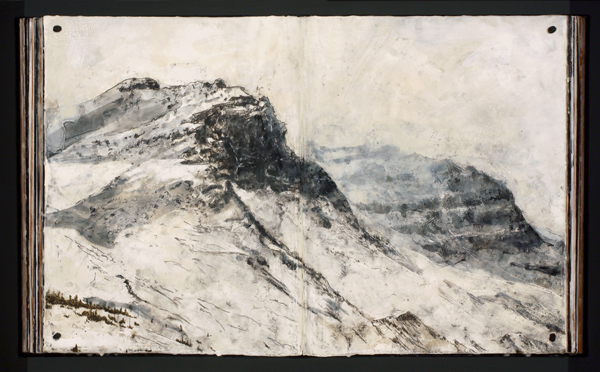
Alexandre Masino, L’ écume du temps (Ehon), 2015; encaustic, charcoal, and antique nails on book on panel; 17 x 28.5 inches


Alexandre Masino, L’ écume du temps (Ehon), (side view)

“Ehon, the title of my series of mounted books, is a Japanese word that means picture book. The pages of the sketchbooks are embedded in wax, transforming them into objects of mystery where only one layer is visible but where the accumulation of previous state is primordial to the global meaning and effect.”

______________________________________________________________________


Tracy Spadafora


Tracy Spadafora, Intervention (Part 4), 2017, encaustic and mixed media on braced wood panel, 20 x 20 inches

“My DNA Series addresses issues of environmental concern. I use DNA sequences (text) to provide visual patterning and symbolic reference. Images and organic material are combined with the text to suggest a complex and shifting relationship between humans, their biological roots, and the shaping of our natural environment.”


______________________________________________________________________


Patricia Dusman


Patricia Dusman, Only Words (Greys), 2016, encaustic on panel,16 x 16 inches

“I write my innermost thoughts into the wax as if scribing on ancient tablets and often repeat it until legibility gives way to pattern. The words become hidden and buried much like our own thoughts and memories that are jumbled deep in our brains.”


______________________________________________________________________